Blog 5: Primate Thanatology
Blog 5: Primate Thanatology
Nicole Anguiano

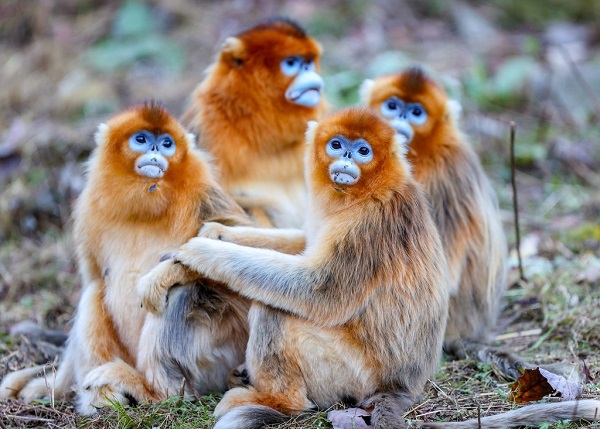
For this last blog post, I wanted to cover a topic that resonates with my career interest and future. Primate thanatology, or the study of death in non-human primates, examines how primates respond and behave towards death. As someone aspiring to work in the mortuary science field as a mortician, I find the topic of loss, and its cultural, social, and psychological implications, fascinating as it highlights the complex social and emotional intelligence present in living organisms. I chose the Northern Plains Gray Langur as my species for these blog assignments out of pure accident. In the beginning of semester, I stumbled upon a Youtube video of gray langurs mourning the death of a fake spy baby monkey (Video 1). There was something so powerful about seeing our non-human relatives comfort one another (Figure 1) in a way so similar to humans that I knew I had to explore more about them. As we have seen throughout the semester, many of the emotions and actions we think as purely human are actually present in many non-human primates, and reacting to death is no different. For this post, I will be summarizing the findings of André Gonçalves and Susana Carvalho’s 2019 article, “Death among primates: a critical review of non-human primate interactions towards their dead and dying,” to explore the evolutionary significance of primate thanatology.
Gonçalves and Carvalho’s article explores the history, development, and future directions of primate thanatology. They begin by examining how the subject was perceived during the 19th and 20th centuries, noting that although early observations were anecdotal and often framed with anthropomorphism, three recurring patterns in primate behavior toward the dead emerged: (i) carrying or dragging corpses, (ii) defending corpses from outsiders, and (iii) displaying signs of grief. Observations from prominent early scholars such as Robert Yerkes, Eugéne Marais, and Jane Goodall further corroborated these findings, describing grief-like reactions to death such as loss of appetite and distress calls, suggesting an awareness and comprehension towards death.
More recently, contemporary data regarding the most widely reported thanatological behavior, dead-infant carrying, has concluded in a wide range of potential hypotheses (Figure 2). Females from several different primate species (Figure 3) have been seen carrying their deceased infants for extended periods, sometimes over 10 days. This behavior is quite interesting as the authors explain that carrying a dead infant is maladaptive as it hinders movement in foraging and predator avoidance. Yet, this behavior continues to occur throughout species raising questions as to why. In the 1980’s, some researchers proposed that carrying dead infants may have had an evolutionary advantage in the past. By carrying an infant that seems dead, but is merely unconscious or temporarily immobile, mothers could avoid accidentally leaving their babies behind. Given primates' slow life histories, this precaution would ensure that the energy invested in having a child would not go to waste. Though no one single hypothesis can be used to explicitly answer this phenomenon, it is likely a combination of factors including primate evolutionary history, anatomical structure of primate species, psychological mechanisms, cognitive abilities, life history, and ecological impact that influence the action and its duration.

Figure 2. Dead-infant carrying hypotheses. From Gonçalves & Carvalho, 2019.

Figure 3. Dead infant carrying behavior distribution across primate taxa. From Gonçalves & Carvalho, 2019.
The comprehensive findings in Gonçalves and Carvalho’s article emphasize that primate responses to death, as seen with dead-infant carrying, are not random actions and emotions, but behaviors tied to deep evolutionary roots. Through their proposed Life-Death Awareness model, the authors suggest that primates are capable of death awareness through perceptual categorization, associative concepts, and high-order reasoning. Though it seems that certain thanatology interactions can be costly, they likely serve adaptive functions like managing grief, updating social hierarchies, creating new social bonds, and reducing caregiving behaviors.
In regards to Northern Plains Gray Langurs and their specific thanatological behaviors, an article from 1980 by Surendra Mal Mohnot details the behavioral changes in an infant langur after losing their mother in a falling incident. Within minutes of the death, the orphaned infant rushed to her mother and began touching her, pulling her hair, engaging in breastfeeding, and screaming; behaviors the infant believed would wake their mother. Within the first hour, the dominant male and other adult female group members began communicating loud “whoops,” a type of vocalization used for altering danger, towards the watchman who killed the langur mother. Some individuals in the group bared their teeth and thumped the ground at the author whenever getting close to the dead mother. Activities within the social group such as playing and feeding significantly decreased until 3 hours after the incident. By the 3th hour mark, the orphaned infant began to stay close with an older aged female who would engage in allomaternal care, periodically feeding, grooming, and carrying the infant. By the 5th week after the mothers death however, the infant showed no significant improvement in social and feeding behaviors and began showing indifference towards the foster mother. In turn, the allomother and other group members showed no interest in the infant and on the 58th day, the orphaned infant was no longer seen. The author presumed she had died, falling prey to predators due to her inactivity and sluggishness.
While this example in gray langurs specifically looks at infant behavior, not mother behavior, it still gives great insight into the negative pressures death has on non-human primate species. In her article, Mohnot explains that the amount of “emotional distress” the infant experienced, seeing her mother die and being taken away, likely caused her indifference towards her community and health. Mohnot notes that the infant’s “fear” response significantly decreased towards her death, with the infant allowing Mohnot to get close to her without much care. This is likely due to the lack of social learning and maintenance in the absence of the infant's mother. While allomothering is common in gray langurs, it does not always result in strong social bonds. In this case, the infant’s indifference towards clinging efforts and failing health may have caused a poor relationship between herself and the allomother.
While there is still much left to uncover in primate thanatology, I find the research that is available extremely vital in understanding the extent of emotional and social intelligence present in our non-human relatives. As the research suggests, primates exhibit cognitive abilities that allow them to acknowledge death. Their responses, such as withdrawal from social bonding, isolation, and decreased feeding behaviors, are evidence that death has a significant impact on individuals. While certain thanatological behaviors, like dead-infant carrying, may have origins in evolutionary survival tactics, I believe that as primate social and cognitive intelligence evolved, their behaviors and emotions toward death moved beyond pure survival mechanisms. Although we have not arrived at a single explanation for thanatological behaviors in primates, the mere fact that they exhibit such actions is a testament to their unique culture. I want to conclude by emphasizing that while non-human primates and humans share similar responses to death, we should be cautious not to impose human cultural actions and beliefs towards death onto non-human primates.
Gonçalves, A., & Carvalho, S. (2019). Death among primates: a critical review of non-human primate interactions towards their dead and dying. Biological Reviews, 94, 1502-1529. doi: 10.1111/brv.12512
Mohnot, S. M. (1980). Behavioural Changes in Hanuman langur Infant after Mother’s Death. Zoologischer Anzeiger, 205, 67-75.


Comments
Post a Comment