Blog 4 Probiscis Monkeys Communication, Social Behaviors, & Cognitive Abilities
Blog 4 Probiscis Monkeys Communication, Social Behaviors, & Cognitive Abilities
Communication
Proboscis monkeys mainly focus on using vocalizations, visual signals, tactile interactions, and will occasionally use olfactory cues to communicate. One of their most prominent features in their large noses that allow them to produce loud nasal honks that can dominant other males and keeps order within their groups. According to Balolia these honks serve multiple purposes, those are to deter rival males, maintaining group cohesion, and signaling strength to females. What's interesting about this is that these calls aren't just loud they also contain information about the size of the male, making their size a key a factor in mate competition and within their social ranking. The other group members like the females and juveniles, produce softer vocalizations to help communicate with the group for movements. Proboscis monkeys will also use visual cues like facial expressions or opening their mouths to threats to show that they are either submissive or dominate. They will also use tactile communication, such as grooming which servs as a way to create social bonds and calm individuals as well as keeping everyone clean.
Social Behaviors
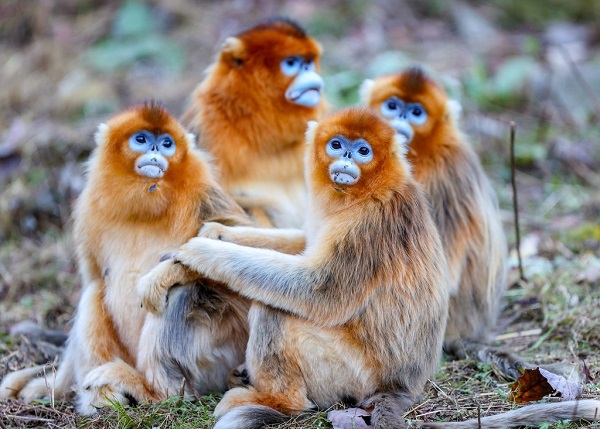
Proboscis monkeys are very social they live in groups of one male and multiple females, or all male groups. They tend to be relatively peaceful especially when compared to other primates. They will often form larger groups especially when they are sleeping which really shows how close they are and how easily flexible their groups are. According the the Wisconsin National Primate research Center, proboscis monkeys will groom others however its primarily the adult female grooming the infants. The males will rarely every be groomed and rarely ever groom someone else. However peaceful Proboscis monkeys are they still do get in fights usually protecting their mates from another male. This peacefulness does however lead to a orderly group, that can shift to anxious group members if another male comes around look to be dominant.
 A diagram of how monkeys form their own groups Cognitive Abilities

While Proboscis monkeys haven't really been studied as much as apes what we have learned from apes can be applied to these monkeys. They have the ability to recognize social hierarchies, communicate effectively through varied calls, and use coordinated group behavior for protection. According to Amici group sizes and social structures are often correlated to the brain region used for processing social information even in monkeys. They also have a form of ecological intelligence, specifically in their ability to navigate rivers and the fragmented habitat of the mangroves. Proboscis monkeys are great swimmers using their skills to not only move between areas but also escape predators. According to Hofmann they are showing adaptive learning which is when they take what's in their environment and adapt to it.
References
Balolia, K. L., & Fitzgerald, P. L. (2024). Male proboscis monkey cranionasal size and shape is associated with visual and acoustic signalling. Retrieved from https://www.nature.com/articles/s41598-024-60665-8
Mettke-Hofmann C. Cognitive ecology: ecological factors, life-styles, and cognition. Wiley Interdiscip Rev Cogn Sci. 2014 May;5(3):345-60. doi: 10.1002/wcs.1289. Epub 2014 Apr 1. PMID: 26308568.
Amici F, Aureli F, Call J. Fission-fusion dynamics, behavioral flexibility, and inhibitory control in primates. Curr Biol. 2008 Sep 23;18(18):1415-9. doi: 10.1016/j.cub.2008.08.020. Erratum in: Curr Biol. 2013 Jul 8;23(13):1267. PMID: 18804375.


Comments
Post a Comment