Blog Post 3 The Mandrill
Blog Post 3 The Mandrill
Social Organization, Social Structure, Mating System, and Care System

Social Organization:
Mandrills tend to live in large groups known as "super-groups" or "hordes". These groups usually consist of up to 800 individuals with an average of about 100-200. Inside these "hordes" there are various subgroups that's are matrilineal meaning the mother is the most important. The sub-groups tend to range from about 10-30 individuals. Females help to keep the social cohesion of the groups and help to maintain order when conflicts arise. When together, the super-group will be lead by a dominant alpha male however when they break apart into the subgroups, the most dominant female becomes the alpha. This helps to ensure a higher chance of survival for their offspring. Often times within a super-group there will be between two-six subgroups. The subgroups will break off and go in different directions to forage their home range before eventually converging back together to form the super-group. Males that are less dominant will eventually break off from the super-group in hopes of finding a mate and to become the alpha male of another group(San Diego Zoo, 2024).

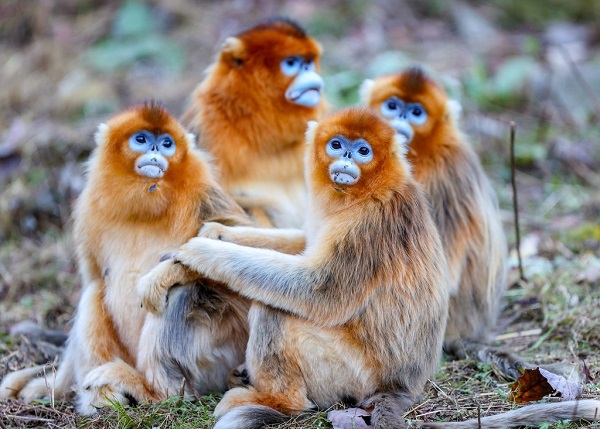
Image of a subgroup of female and young male mandrills
Social Structure:
Mandrills tend to live in a Hierarchical society that consists of an Alpha Male, multiple dominate females, and several less dominate or juvenile males. When in their super-group, their is one alpha male that has reign over them all however when in their subgroups, the alpha female is in charge. Mandrills are very vocal. When they are foraging with their sub-groups, they are often howling, chattering, or grunting. These communication calls help the other subgroups to know where their super-group members are and help to desern what territories are theirs. Males will also mark their territory through scent marking. These scents are created through a gland in their chest.When reaching maturity, females will typically stay in their natal group as they will inherit the social status of their mother. Males on the other hand will either challenge the alpha for superiority over the super-group or leave in search of another group (Denver Zoo, 2024).

Image of two male Mandrills fighting presumably over superiority
Matting and Care systems:
Mandrills mate in a Harem structure where the dominate or alpha male controls the breeding rights to all the females of his super-group. Mandrills do not have a typical breeding season. Instead the mate every two years sometime between July and October. Females will only have one offspring at a time and their gestation period is about six months. Multiple females will contribute to raising that one offspring. This includes aunts, cousins, sisters, etc. These females will often times be the ones to provide enrichment for the infant. Playing, grooming, and carrying it when the other cannot. The male is usually less involved. The males main job is to protect his harem and offspring from rival males. However males will occasionally play with their offspring. In the event a rival male defeats the alpha, he will kill all of his offspring and take over the harem. The male mating strategy is simply to be the alpha as it brings exclusive rights to as many females as he wants. Females on the other hand usually choose to mate with the most dominate male. This however is not always the case. Females tend to look for a male with the brightest colors which is usually the alpha. Due to the females preferring those with brighter colors, there exists a high level of sexual dimorphism in Mandrills. Male mandrills exhibit the most dimorphism in their snout and face coloration as well as in their canine size. When a male takes over the alpha position, either through force or simply opportunity, their snout colors will become more vibrant. This increased coloration is due to an increase in blood flow to the snout caused by a hormonal release that is triggered by assuming the alpha position.(Ingmarsson, 2020).

Image showing female Mandrill feeding infant
References:
Denver Zoo Conservation Alliance. (2024, July 3). Mandrill. Denver Zoo. https://denverzoo.org/animals/mandrill/
Ingmarsson, L. (2020). Mandrillus Sphinx (Mandrill). Animal Diversity Web. https://animaldiversity.org/accounts/Mandrillus_sphinx/#:~:text=Reproduction,only%20been%20observed%20in%20capivity.
Mandrill. San Diego Zoo Wildlife Alliance Animals and Plants. (n.d.). https://animals.sandiegozoo.org/animals/mandrill


Comments
Post a Comment